
Por que o ICE deve ser compreendido como terrorista?
- Mirna Wabi-Sabi

- 24 de jan.
- 4 min de leitura
Leia em Português na Le Monde Diplomatique.
On January 7, 2026, Renee Nicole Good — a 37-year-old mother, poet, and Minnesota resident — was fatally shot by an ICE agent in Minneapolis. Good was not a violent criminal; according to multiple eyewitness accounts and videos, she was unarmed in her vehicle during a large federal immigration enforcement operation when an agent fired multiple times, killing her. People denouncing and defending this murder invoke "domestic terrorism" as the explanation for this horrific situation.
Domestic terrorism consists of violent, criminal acts committed by individuals or groups to further ideological goals; it's preposterous to have a debate about who in this scenario is the real terrorist. Good was peacefully resisting the actions of agents of an ideological institution that commits violent crimes to in still fear in marginalized contingents of American society, and faced their deadly ire.
Good’s death is an extreme example of how federal agencies with broad, vaguely constrained powers can enact lethal force on civilian populations without transparent accountability — and why any sensible citizen argues these agencies operate in ways that terrorize communities. Justifiably, her death has led to widespread protests.
The role of ICE in contemporary U.S. society is comparable to various forms of state policing whose violence is structurally tolerated and normalized, such as Brazil’s Military Police in favelas and the IDF in Palestine. These institutions operate with expansive authority, little civilian oversight, and use lethal force disproportionately against marginalized communities, contributing to patterns of fear and repression rather than safety.
In Rio de Janeiro, Military Police operations in favelas have resulted in repeated massacres, with indiscriminate shootings and high civilian casualties. These operations often amount to collective punishment that terrorizes residents, and disproportionately affects Black and poor populations. In Palestine, the IDF’s occupation, settler protection, and blockade policies has produced widespread civilian casualties and destruction, often without transparent accountability mechanisms, reinforcing structural power imbalances and terrorizing communities.
This pattern indicates not just isolated events, but systemic violence inherent in policing structures. ICE, a federal agency responsible for immigration control, carries out operations well beyond the U.S. border and employs aggressive tactics that instill fear, cause injury, and result in death within immigrant communities and, as is evident, far beyond.


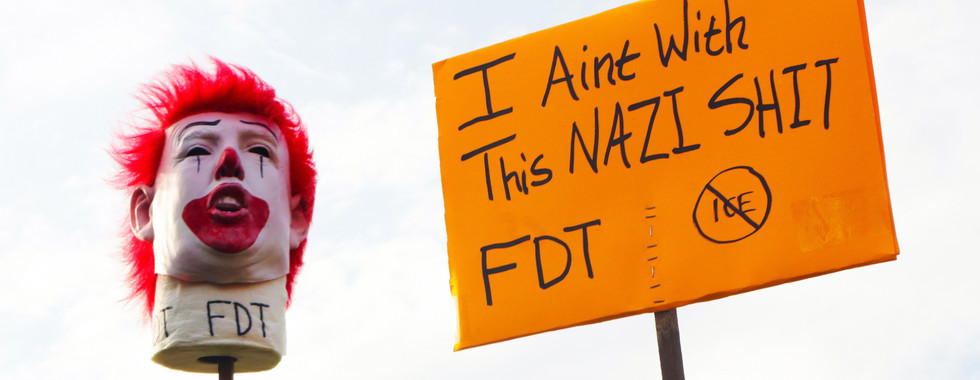


Photos of the rally and march "Ice/Border Patrol Out of NOLA!" in New Orleans, January 10th, 2026. By Mirna Wabi-Sabi.
State Violence is Terror
Defenders of ICE emphasize its legal mandate to enforce immigration laws. Opponents argue that when enforcement agencies use overwhelming force without accountability, the effect is state terrorism — that is, the systematic use of violence by governmental agents to control, intimidate, or repress civilian populations. This understanding calls attention to the terrorizing impact on communities who live under the constant threat of unaccountable force.
Renee Good’s killing became a flashpoint because it occurred during an operation that had been terrorizing residents of Minneapolis for weeks. Just as police militarization in Brazil’s favelas is criticized for fostering a climate of fear and extrajudicial violence, the IDF's operations result in civilian deaths that traumatize Palestinian. Meanwhile, ICE’s domestic operations, conducted with limited local oversight, produce fear and trauma among immigrants and the broader public.
Community Control as an Antidote
The National Alliance Against Racist and Political Repression (NAARPR) advocates for structures that directly address this terror threat by placing civilian oversight and accountability at the center of policing and enforcement. True oversight requires community participation, transparency, and power to shape law enforcement policy and discipline.
NAARPR’s Campaign for Community Control of Police exemplifies this approach by demanding that communities, not just internal departmental review boards, have the authority to oversee police operations, budgets, and disciplinary proceedings. By democratizing control over public security, these movements aim to reduce violence and increase accountability, ensuring that agencies cannot operate as unregulated forces of coercion.
Groups like Eye on Surveillance are part of the civil society infrastructure that pushes for such oversight to exist, by demanding transparency from police and surveillance operators, and connecting communities to their rights and to policy efforts that can lead to formal structures of accountability.
This network researches how surveillance systems, from facial recognition to predictive policing, are deployed without public consent and without adequate transparency, often targeting the vulnerable to enforcement violence.


Whether it is ICE’s domestic raids, militarized police operations in Brazil, or surveillance technologies deployed by the IDF and globally, the underlying dynamics are: agencies equipped with state power and technological capacity act without community consent, producing terror. Civilian oversight and transparency mechanisms challenge this by bringing policing and surveillance under public control rather than leaving them in the hands of insulated enforcement bureaucracies.
From Minneapolis to Rio de Janeiro, to Gaza and conflict zones around the globe, state violence under the guise of security creates environments where civilians are terrorized by the very forces meant to protect them.
Recognizing that agencies like ICE and militarized police forces can act in ways that terrorize communities is not merely rhetorical; it is a call for structural transformation. Advocates for community control of police and civilian oversight offer concrete alternatives to unchecked state power, demanding transparency, accountability, and democratic governance of policing.
If we are to live without fear of arbitrary or lethal state force, oversight structures must be rooted in communities themselves, empowered to shape policy, enforce discipline, and ensure that enforcement serves public safety rather than repression and terror.
________



Comentários